
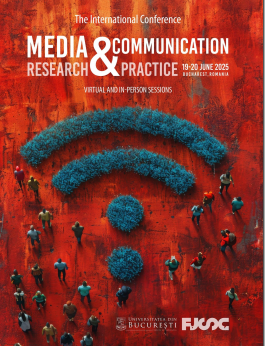


Faculty of Journalism and Communication Sciences, University of Bucharest Call for Papers: Media and Communication Research and Practice 2025
INTERNATIONAL CONFERENCE, 19-20 JUNE 2025, VIRTUAL AND IN-PERSON
In an era marked by rapid digital transformation, public discourse is no longer solely shaped by traditional institutions. Digital technologies have empowered citizens to engage directly in the public sphere, thereby reshaping the “network society” (Castells, 2009) and reducing the intermediary role of established institutions. This shift has enabled a more immediate and participatory form of communication consistent with the evolving nature of the civic culture. While such transformations bring individuals closer to public debate, they also raise significant concerns about the contemporary public space – one that, instead of fostering rationality and inclusivity, digital platforms often amplify trends toward polarization, immediacy, and incivility (Sunstein, 2017).
The Media and Communication Research and Practice Conference 2025 invites scholars, researchers, practitioners, and educators to engage in an interdisciplinary dialogue on the evolving dynamics and challenges in communication across various platforms and spaces. The conference aims to provide an interdisciplinary platform for examining emerging innovations, transformative trends, and persistent challenges while fostering discussions on both theoretical insights and practical solutions in the fields of communication and media studies.
We welcome papers across a variety of thematic areas, including but not limited to:
- Political Communication in the Age of Digital Transformation
The year 2024 was not simply an election year – it may very well have been the defining election year of the decade. With a record number of countries, including the member states of the European Union, holding national elections, nearly half of the world’s population was called to the polls. From regime changes and sweeping reforms to the unexpected resurgence of figures like Trump, these elections have the potential to redefine global political and social trajectories. They also underscore critical issues such as the global rise of populism (Mudde & Kaltwasser, 2017) and the deepening of polarization, particularly fuelled by online platforms that deepen divides and complicate consensus-building within democratic societies. Against this backdrop, the conference will explore how political communication – shaped by digital innovation and the immediacy of real-time interaction real-time interaction – continues to influence the democratic process (Chadwick, 2013; Castells, 2009). Topics of interest include:
The Impact of Digital Technologies on Political Communication: How have digital technologies reshaped the public discourse and the public sphere, making it more accessible yet also more vulnerable to polarization and populism?
The Role of Polarization and Populism in the 2024 Elections: In what ways does populist discourse manifest in the 2024 elections, particularly in the context of European Parliament elections, and what risks does it pose to liberal democracy?
Visibility, Exposure, and Discursive Positioning of Political Actors: Research into how public visibility influences the rhetorical strategies and discursive positioning of political parties, public figures, and media institutions. How does the visibility of mainstream actors differ from those on the political margins, who often pursue more radical rhetoric?
The Impact of Fake News and Conspiracy Theories on the Electoral Process: The rapid spread of misinformation and conspiracy theories in digital media often amplified by algorithmic systems and echo chambers exacerbates vulnerabilities within the electorate, fostering a climate of confusion, polarization, and extremism.
- The Changing Media Landscape in Europe and Beyond
This thematic area invites research on the evolving dynamics within media systems, focusing on three key aspects. Firstly, it examines the shifts in government and policy, analyzing how regulatory changes reshape media environments, potentially altering the structure of the public sphere and influencing democratic deliberation (Habermas, 1989). Secondly, it addresses the critical issue of journalism funding, exploring how primary funding sources impact editorial independence, media pluralism, and the diversity of perspectives in news coverage , reflecting broader concerns about the monopolization of media ownership. Finally, it investigates the role of technology in the public sphere, particularly the influence of automation and algorithm-driven content distribution, which increasingly shapes public discourse and raises questions about the dominance of tech monopolies in the digital age. Together, these factors redefine the media landscape, raising critical concerns about democratic processes, public engagement, and media accountability in an era where commercialization and technological domination challenge traditional norms of transparency and inclusivity.
Government Policies and Media Regulation: How are shifts in policy and regulation affecting media environments, public access to information, and media freedom?
Journalism Funding and Editorial Independence: What is the impact of various funding models, including public funding, corporate sponsorships, and private investments, on editorial decision-making, media pluralism, and the diversity of content in journalism
Technology in the Public Sphere: How do innovations in automation (e.g., algorithm- driven recommendations, AI-generated news), algorithmic content distribution, and AI shape public discourse, the reach of news media, and political engagement?
Security and Journalistic Practice: What are some of the challenges facing journalists who seek to have professional standards and personal safety maintained in the face of increased digital surveillance, targeted harassment, and physical threats? What steps might media organizations and policymakers take to ensure safety and well-being for journalists while protecting press freedom?
- Marketing and Communication in the Digital Age
The digital age has redefined marketing and communication strategies, transforming how brands and organizations engage with their audiences through dynamic, data-driven, and interactive approaches. Social media campaigns, influencer marketing and personalized content strategies illustrate the shift toward two-way communication that fosters deeper relationships between businesses and consumers (Kotler, 2021). The integration of digital technologies, such as real-time analytics and algorithm-driven personalization, has also reshaped public relations, brand management, and consumer behavior by embedding these practices within networked digital ecosystems (Castells, 2009). This thematic area invites research into the evolving role of communication in marketing, particularly focusing on strategies that leverage digital technologies to influence decision-making processes and build brand loyalty.
Digital Marketing Strategies: How have digital technologies transformed marketing practices, particularly in areas such as social media outreach, personalized advertising automation, and data-driven decision-making?
Influencer Marketing: What role do influencers play in shaping brand narratives, consumer trust, and public opinion in the digital age, and what challenges arise from their growing influence on marketing practices?
Ethical Considerations in Digital Marketing: What are the ethical challenges associated with digital marketing, particularly regarding privacy, data collection practices, and the use of targeted engagement strategies?
The Media and Communication Research and Practice Conference 2025 aims to provide an interdisciplinary platform for rigorous academic discussion and the exchange of ideas on key challenges facing media and communication today. We encourage submissions that use diverse methodologies, including longitudinal, comparative, cross-sectional as well as experimental, ethnographic, or mixed-method approaches, to explore these pressing issues. The conference will bring together scholars, researchers, practitioners and emerging voices in the field to discuss the future of communication in an increasingly digitized world and its impact on public life, politics, and society.
Submission Deadlines:
- Abstract submission deadline: 1.05.2025
- Full paper submission deadline: 1.07.2025*
- Please submit abstracts and papers to: conference@fjsc.ro
Practical Information:
The abstract (300 words) will contain author’s/authors’ details, the study’s purpose, research questions, employed methodology or approach, (potential) results, including references (please use the template included below).
The submission languages are Romanian and English. The time allocated to each presentation will be 15-20 minutes, and it can be delivered online or face to face (the corresponding author is expected to express this choice when submitting the abstract).
Panel proposals are welcomed. Please get in contact with the congress organizers if you are interested in organising a panel.
If you have further questions, please contact the organizers at the address: conference@fjsc.ro
Conference Fee:
- Standard participation – 50 EUR
- Standard online participation – 25 EUR
- PhD student participation – 25 EUR
